

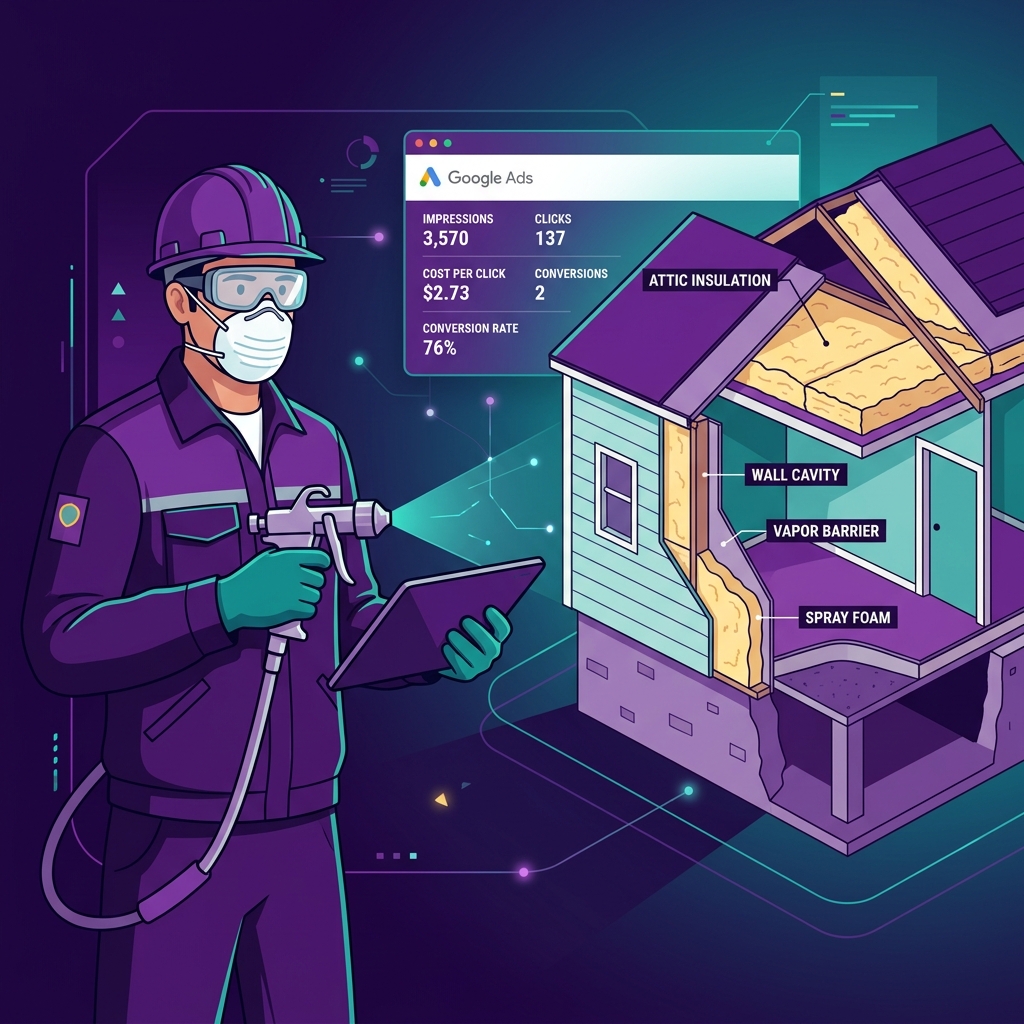
1. Why PPC Is Uniquely Effective for Insulation Companies
Unlike brand-building channels, PPC captures demand that already exists. When a homeowner notices their energy bills have doubled or they’re experiencing temperature inconsistencies in their home, their next move is almost always a Google search: “attic insulation contractor near me” or “spray foam insulation cost.”
PPC puts your business directly in front of these high-intent moments. The key advantages for insulation companies specifically:
- High job value: A $200/lead cost is profitable if your average job is $4,000.
- Clear seasonal peaks: You can increase ad spend before spring and fall HVAC checkup seasons and pull back in slower months.
- Geographic precision: You only pay to reach homeowners in your actual service area.
2. Choose the Right Advertising Platform
For insulation companies, the priority platform stack in 2026 is:
- Google Local Service Ads (LSAs): If eligible, run these first. Pay per lead, not per click. Google Guaranteed badge builds instant trust.
- Google Search Ads: Target high-intent keywords at the moment of need. Your primary volume driver.
- Meta (Facebook/Instagram) Ads: Best for retargeting website visitors and running seasonal awareness campaigns (“Is your attic insulated properly? Winter is coming.”).
- Google Display Remarketing: Re-engage visitors who viewed your services but didn’t call or submit a form.

3. Define Your Business Goal Before You Spend a Dollar
Every dollar in your PPC budget should be tied to a specific, measurable goal. For most insulation companies, the primary goal is booked estimate appointments — not just website traffic. Define:
- Your maximum acceptable cost per booked estimate
- Your target service area (city, county, or radius)
- Your primary service to promote (attic insulation, spray foam, soundproofing, etc.)
- How leads will be tracked (phone calls, form submissions, or both)
4. Research Your Audience — Homeowner Psychology Matters
Insulation buyers are typically homeowners aged 35–65 who are either remodeling, dealing with comfort issues, or motivated by energy savings. In 2026, key audience insights:
- Energy efficiency messaging resonates strongly — tie your ads to lower utility bills, not just product specs.
- Trust signals matter enormously — license numbers, BBB ratings, and Google reviews in your ad copy reduce friction.
- Mobile is dominant: Over 70% of local service searches happen on mobile devices. Your landing page must load in under 2 seconds on mobile.

5. Keyword Research for Insulation PPC
Focus your keyword research on three categories:
- Service + location: “attic insulation [city]”, “spray foam insulation contractor [county]”
- Problem-aware: “house too hot upstairs”, “high energy bill fix”, “cold floors insulation”
- Comparison/cost: “insulation installation cost”, “spray foam vs fiberglass insulation”, “free insulation estimate”
Use Google Keyword Planner and your own Google Search Console data to identify terms with proven conversion history. Add aggressive negative keywords: “DIY,” “how to install,” “rent,” “apartment” — these are non-buyer searches that waste budget.
6. Segment Your Keywords into Tightly Themed Ad Groups
Each insulation service type should have its own dedicated ad group with its own ad copy and landing page. A visitor searching for “spray foam insulation” should land on a spray foam-specific page — not a generic insulation services overview. Message match between your ad and landing page is one of the highest-impact conversion optimizations available in PPC.
Ad group structure for insulation companies:
- Attic Insulation
- Spray Foam Insulation
- Blown-In / Batt Insulation
- Crawl Space Insulation
- Insulation Removal & Replacement
- Commercial Insulation (if applicable)
7. Write Ad Copy That Converts Homeowners
Your ad competes with 3–5 other insulation companies on every search. Differentiate with specifics:
- Headline 1: Lead with the service + city: “Attic Insulation Sacramento”
- Headline 2: Lead benefit: “Save Up to 40% on Energy Bills”
- Headline 3: Trust signal: “Licensed · Insured · 4.9★ 200+ Reviews”
- Description: “Free in-home estimates. We use eco-friendly materials and finish most jobs in one day. Call now for same-week scheduling.”
Always include ad extensions: call extensions (with click-to-call on mobile), location extensions, sitelinks to specific service pages, and callout extensions (“No Mess Guarantee,” “Family Owned,” “Veteran Friendly”).
8. Geo-Target Your Exact Service Area
Set campaign targeting to “People in or regularly in your targeted location” (Presence only). Exclude areas outside your service radius. Bid more aggressively on ZIP codes or neighborhoods with older housing stock — these homes are most likely to need insulation upgrades and have the highest average job values.
9. Use a Smart Bid Strategy Matched to Your Data
- New account (0–30 conversions): Maximize Clicks with a manual CPC cap. Gather data first.
- Growing account (30–100 conversions): Maximize Conversions with a Target CPA set 20% above your actual historical CPL.
- Established account (100+ conversions): Target ROAS or Target CPA. Let the AI fully optimize — but monitor weekly.
10. Continuously Optimize — PPC is Not Set-and-Forget
Successful insulation PPC requires weekly management:
- Review Search Terms report weekly — add converting terms as exact match, add irrelevant terms as negatives.
- A/B test ad copy monthly — change one element at a time (headline, CTA, or benefit claim).
- Monitor Quality Score — low QS increases your cost per click. Improve by tightening ad-to-landing-page message match.
- Review conversion tracking monthly — phantom conversions (bots, accidental clicks) inflate your data and mislead bidding algorithms.
- Adjust budgets seasonally — increase spend in Q1 (post-winter audits) and Q3 (pre-winter prep). Pull back in peak summer if your area’s demand drops.
SpringHive manages PPC campaigns for home service businesses including insulation contractors. We handle keyword research, ad creation, landing pages, conversion tracking, and weekly optimization. View our PPC service or get a free audit today.