

1. Fully Optimize Your Google Business Profile
Your Google Business Profile (GBP) is the single most impactful local SEO asset for an HVAC company. An optimized GBP dramatically improves your visibility in the Google Maps 3-Pack — the three business listings that appear above organic results for local service queries.
- Complete every field: hours, services, service area, attributes (“Women-Led,” “Veteran-Owned,” etc.)
- Add real photos weekly — trucks, technicians, completed jobs, your team
- Post weekly GBP updates (promotions, seasonal tips, service reminders)
- Enable messaging and respond to every message within 1 hour
- List all HVAC services individually with detailed descriptions
2. Master On-Page SEO for Every Service Page
Each HVAC service you offer — AC installation, heating repair, duct cleaning, furnace replacement — should have its own dedicated page with full on-page SEO optimization:
- Primary keyword in title tag, H1, URL slug, and first 100 words
- Semantically related terms throughout the page body (LSI keywords)
- Internal links to related service pages and blog posts
- Meta description under 160 characters with a clear call-to-action
- Image alt text describing the content accurately with location context
3. Build a Local Keyword Targeting Strategy
Generic HVAC keywords (“HVAC repair”) are dominated by national brands. Win local traffic by targeting geo-modified, high-intent keywords your competitors are ignoring:
- “AC repair [neighborhood name]”
- “HVAC company [county] CA”
- “Emergency furnace repair [city] + 24 hours”
- “Ductless mini split installation [city] cost”
Use Google Search Console to identify which keywords already drive impressions to your site — these are your lowest-hanging ranking improvements.
4. Build E-E-A-T Signals Throughout Your Website
Google’s 2026 ranking algorithm places enormous weight on E-E-A-T: Experience, Expertise, Authoritativeness, and Trustworthiness. For HVAC companies — classified as YMYL (Your Money or Your Life) because poor HVAC work can cause safety issues — Google applies extra scrutiny.
- Display HVAC certifications (NATE, EPA 608, manufacturer certifications) prominently
- Include a detailed “About Us” page with real team bios and photos
- Show your license number and insurance information on every page footer
- Publish case studies or before/after job documentation with real locations

5. Fix Your Technical SEO Foundation
If Google’s crawlers can’t properly access, render, and index your site, no amount of content will rank. Technical SEO baseline for HVAC websites in 2026:
- HTTPS everywhere — no mixed content warnings
- Clean, crawlable URL structure (no session IDs or excessive parameters)
- Proper XML sitemap submitted to Google Search Console
- No broken links or 404 errors on key pages
- Canonical tags on any duplicate or near-duplicate content
6. Achieve Excellent Core Web Vitals Scores
Core Web Vitals (CWV) are Google’s page experience ranking signals: Largest Contentful Paint (LCP), Interaction to Next Paint (INP), and Cumulative Layout Shift (CLS). In 2026, passing CWV is a baseline expectation, not a differentiator. Failing CWV actively depresses your rankings.

7. Build a Systematic Review Generation Strategy
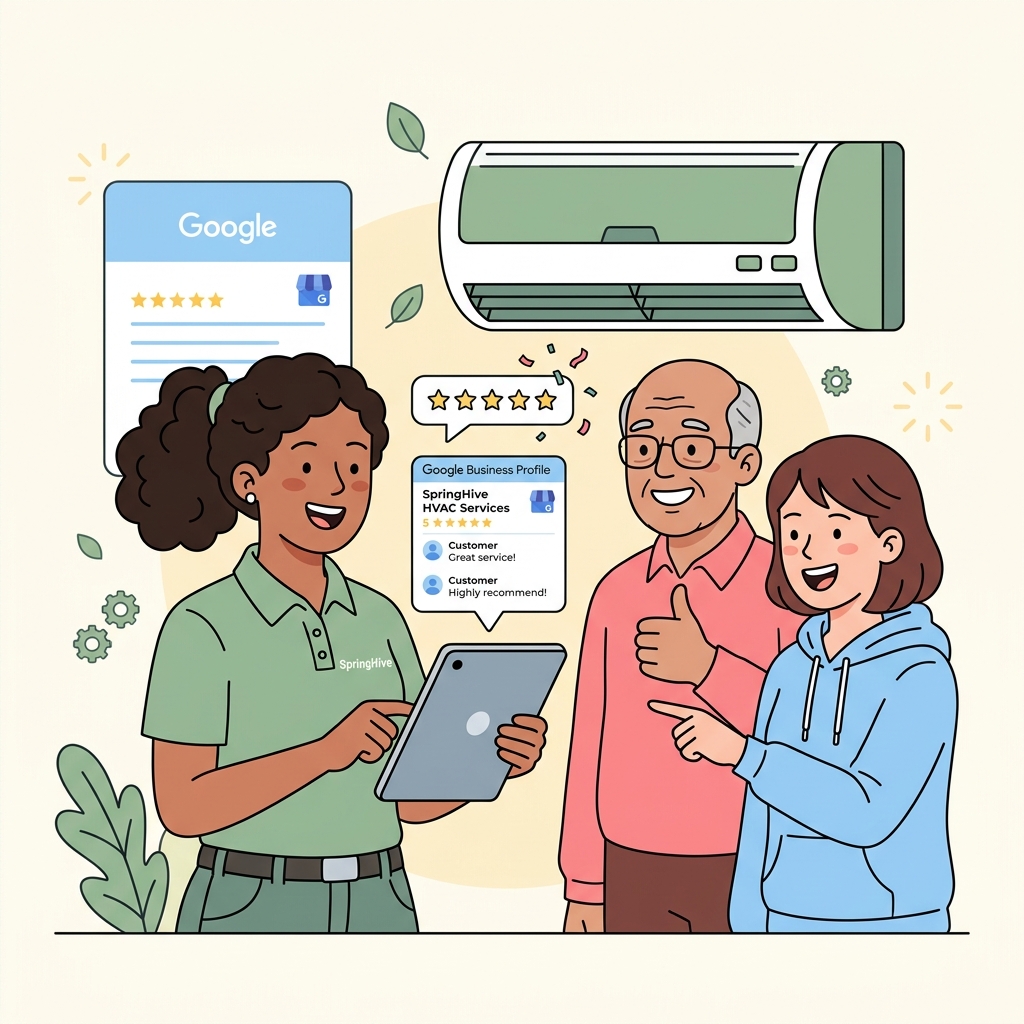
Google Reviews are the most powerful local ranking signal — and the most direct trust builder with potential customers. In 2026, HVAC companies with 100+ recent reviews at 4.7+ average consistently outrank competitors with fewer reviews in the Maps 3-Pack.
- Send a review request SMS or email within 30 minutes of job completion
- Use a QR code on invoices linking directly to your Google Review page
- Train technicians to verbally request reviews after every successful job
- Respond to every review — positive and negative — within 24 hours
8. Build and Maintain Local Citations
Local citations are mentions of your business name, address, and phone number (NAP) on third-party directories. Consistent NAP across Yelp, HomeAdvisor, Angi, BBB, Houzz, and dozens of industry directories reinforces your local authority with Google’s algorithms.
Audit your existing citations for consistency — even minor variations (St. vs Street, Suite vs Ste) confuse Google’s entity reconciliation and weaken your local ranking signals.
9. Create Dedicated Service Area Landing Pages
If you serve multiple cities or neighborhoods, create a unique, high-quality page for each location — not thin duplicate pages. Each service area page should include:
- Unique, location-specific content (local landmarks, climate notes, common HVAC issues in that area)
- Local customer testimonials from that specific area
- Embedded Google Map showing your coverage
- Location-specific schema markup
10. Implement Schema Markup for Rich Snippets
Schema markup (structured data) helps Google understand your content and can unlock rich results in search — star ratings, service lists, FAQ accordions — that significantly improve CTR even without ranking changes.
- LocalBusiness schema with all HVAC service types
- Service schema for individual service pages
- Review/AggregateRating schema from your actual customer reviews
- FAQPage schema on every blog post and service page
11. Publish an HVAC Blog Content Strategy
Content marketing is the fuel of SEO. HVAC companies that publish consistent, helpful blog content attract top-of-funnel homeowners who are researching before they’re ready to buy — and then convert them with retargeting and email when they’re ready.
High-performing HVAC blog content types: seasonal maintenance checklists, “how to” guides (that demonstrate expertise without fully replacing the need for a tech), equipment comparison articles, and local energy efficiency resources.
12. Build Quality Backlinks Through Strategic Outreach
Backlinks from authoritative, relevant websites remain one of Google’s top ranking signals. For HVAC companies, attainable, high-quality backlink sources include:
- Local chamber of commerce and business association listings
- Supplier/manufacturer partner directories
- Home improvement resource websites (sponsor a homeowner resource guide)
- Local news coverage for community involvement, charity work, or emergency response
13. Optimize for AI Search (Google SGE / AI Overviews)
Google’s AI Overviews (formerly SGE) now appear at the top of search results for many HVAC queries. To be cited by AI Overviews, your content must be authoritative, comprehensive, and directly answer specific questions. Structure pages with clear H2/H3 headers per question, provide direct answers in the first sentence, and include data or statistics that AI systems can cite as facts.
14. Invest in YouTube and Video SEO
YouTube is the second-largest search engine and is increasingly integrated into Google Search results. HVAC companies that publish regular YouTube content — maintenance tips, equipment explainers, technician training videos — see lift in both video rankings and Google web rankings for their domain due to Google’s co-ranking signals between YouTube and web content.
Even 1–2 videos per month, properly optimized with target keywords in title, description, tags, and closed captions, can dramatically expand your organic visibility over 6–12 months.
SpringHive delivers local SEO strategies for HVAC companies that build compounding organic traffic over time. From GBP optimization to technical SEO to content marketing — we handle the full strategy. View our Local SEO service or get a free HVAC SEO audit.